
How to Minimize Processing Fees for Union Membership Dues With Stripe and PCI Compliance
A practical guide for unions using Stripe to reduce dues payment costs while keeping PCI scope controlled, member records clean, and reconciliation manageable.
Processing fees are part of modern dues collection, but they should not be treated as an unavoidable mystery line item. A union using Stripe can usually lower the total cost of collection by choosing the right payment methods, reducing failed payments, avoiding unnecessary manual work, and connecting every payment back to the member record. PCI compliance matters at the same time: the goal is to collect dues without letting card data flow through staff inboxes, spreadsheets, website forms, or unmanaged databases.
Use this guide to evaluate Stripe payment method mix, PCI scope, staff handling rules, data residency, dedicated infrastructure, member records, reconciliation, and reporting before changing your union dues processing software workflow.
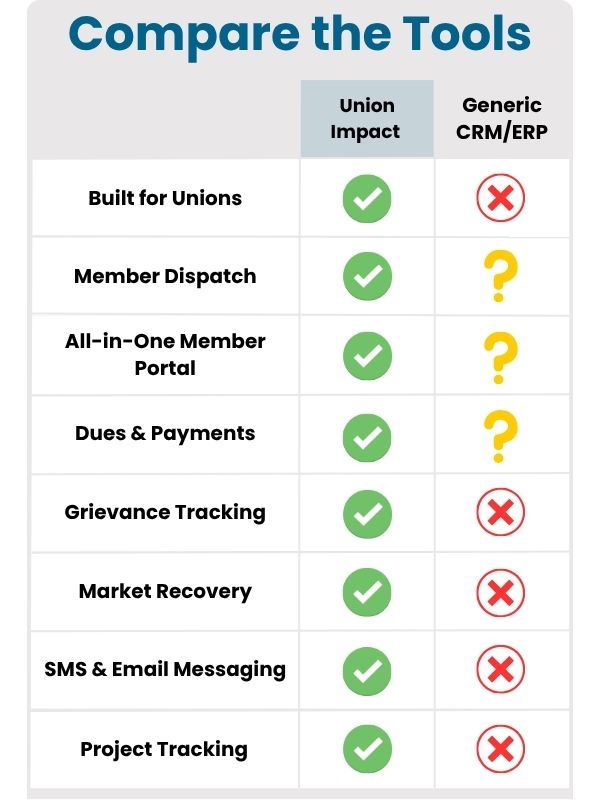
The Practical Answer
For most unions, the lowest-risk answer is not simply “turn on online payments.” The better answer is to build a dues workflow that uses bank payments where they fit, keeps cards available when members need them, and keeps payment handling inside a PCI-aware Stripe flow instead of inside staff-managed forms.
Union Impact should be used as the operating layer around the payment: member identity, dues category, payment status, receipts, reconciliation, staff review, exceptions, and reports. Stripe should handle the sensitive payment collection path. That separation helps reduce fee waste and also limits where card data can appear.
Start With Payment Method Mix
Stripe’s public U.S. pricing page currently lists standard domestic card pricing at 2.9% plus $0.30 per successful transaction, while ACH Direct Debit is listed separately at 0.8% with a $5.00 cap. Those public rates can change and may vary by account, payment method, country, volume, custom pricing, and added products, so a union should verify its current Stripe dashboard and fee schedule before publishing member-facing policy.
The planning point is still straightforward: dues are often recurring and predictable, which makes bank-based payments worth evaluating. Card payments are convenient and familiar, but the percentage plus fixed transaction fee can become expensive across a large membership base.
Why ACH Usually Matters for Recurring Dues
ACH Direct Debit can be a good fit for recurring membership dues when members authorize the payment terms and the union can tolerate delayed confirmation. Stripe’s ACH documentation explains that ACH Direct Debit is reusable, supports recurring payments, and can take up to four business days to receive acknowledgement of success or failure.
That timing matters. ACH is not the same as an instant card approval. A union needs a status workflow for pending payments, failed payments, disputes, return fees, and member follow-up. The savings only help if staff are not forced to reconcile every exception by hand.
Keep Card Payments Available but Controlled
Cards should usually remain available for members who need immediate payment, prefer a card, or are making one-time catch-up payments. The issue is not whether cards are bad; the issue is whether the union treats every dues transaction as a card transaction when a lower-cost recurring bank option may fit many members.
A practical setup can present ACH or bank payment as the default recurring option, keep card payments as a fallback, and show staff which payment method was used. The member record should never depend on staff reading Stripe exports line by line to know what happened.
Do Not Create Fee Policy Risk Accidentally
Some organizations try to recover costs by adding a convenience fee or card surcharge. Do not do that casually. Card network rules, state law, union policy, member authorization language, and disclosure requirements can all matter. A union should review that decision with qualified advisors before charging members extra for a particular payment method.
Often the safer first move is operational: improve payment method mix, reduce failed payments, reduce manual reconciliation, clean up duplicate members, and ask Stripe whether the account qualifies for custom pricing based on actual processing volume.
How Union Impact Should Connect Stripe to Member Records
The payment processor should not be the union’s only dues record. Each Stripe Customer, payment, subscription, invoice, PaymentIntent, Checkout Session, or Payment Link workflow should be tied back to a stable member identifier wherever possible.
Inside Union Impact, staff should be able to see the member, dues type, amount expected, amount received, payment method category, payment status, receipt reference, exception status, and review owner. That lets the treasurer or staff reconcile by exception instead of rebuilding the dues ledger manually.

Serving American Locals: Our platform is built to support unions across the United States, with U.S. locals operating on our U.S.-based systems to keep everything aligned with domestic operations and member needs.

Serving Canadian Locals: Canadian unions are supported through dedicated Canadian infrastructure, ensuring your local’s data, workflows, and member services remain inside Canada—built for Canadian unions, by a team that supports them every day.
PCI Compliance: What Stripe Helps With and What the Union Still Owns
Stripe states that it is certified as a PCI Service Provider Level 1, and its Checkout material says Checkout can help users qualify for simplified PCI validation with a prefilled SAQ A. PCI SSC guidance is more specific about the boundary: SAQ A eligibility depends on all payment page elements coming only from PCI DSS compliant service providers, plus meeting all other SAQ criteria.
The careful wording matters. Stripe can reduce PCI scope when implemented correctly, but it does not remove the union’s responsibility to accept payments in a PCI-compliant way, complete required validation, secure user access, maintain the website, and keep staff from collecting or storing card data outside approved payment flows.
What Staff Should Never Collect
A union should not ask members to type full card numbers into a normal website contact form, email, PDF, spreadsheet, support ticket, shared inbox, or free-text note. Those channels are not the payment page.
If the union uses Stripe Checkout, Payment Links, Billing, or Stripe Elements, keep sensitive payment entry inside Stripe-controlled or Stripe-tokenized components. If a custom Elements implementation is used, follow Stripe’s current integration security guidance, including loading Stripe.js directly from Stripe rather than bundling or self-hosting it.
- Do not store full card numbers in Union Impact member notes.
- Do not accept card details by email or voicemail for staff to retype later.
- Do not paste card numbers into spreadsheets for batch processing.
- Do not send payment screenshots that expose card or bank details.
- Do not give every staff user broad Stripe dashboard access.
Reduce Failed Payments Before Chasing Lower Rates
Failed payments create staff time, member confusion, and sometimes additional fees. The workflow should send clear reminders, provide a secure payment-method update link, identify expiring cards, track pending ACH payments, and separate payment failures from members who simply have not been invoiced yet.
For dues, even small improvements can matter: cleaner member identifiers, consistent billing dates, accurate email and phone records, clear receipt language, and member self-service can reduce support tickets and reconciliation work. The cheapest transaction is not helpful if it creates a manual investigation every month.
Design Around Dues Size and Frequency
The fixed fee on card transactions can hurt smaller, frequent payments. If bylaws, member authorization, and union policy allow it, consider whether monthly or quarterly billing reduces transaction count without confusing members or changing the dues obligation. This is a policy and operations decision, not only a payment setting.
For example, collecting a small amount every week may create more fixed transaction costs than collecting the same authorized dues on a monthly schedule. The union should compare member experience, cash flow, authorization language, staff workload, and reporting needs before changing cadence.
Reconcile by Exception
A healthy dues workflow should make normal payments disappear into a clean ledger and push only exceptions to staff. Exceptions include failed ACH debits, card declines, duplicate payments, refunds, disputes, mismatched member identifiers, payment amounts that do not match the expected dues, and members who paid under the wrong category.
Union Impact’s job is to make those exceptions visible, assignable, and reportable. A payment dashboard should help staff answer: who paid, who is pending, who failed, who needs outreach, who requires treasurer review, and what data needs correction.
Questions to Ask Before Changing Dues Payments
Use these questions before changing member-facing payment pages, dues billing cadence, or Stripe configuration.
- Which dues categories are recurring, one-time, catch-up, assessment, event, or donation-style payments?
- Which payment method should be the default for recurring dues?
- What member authorization language is needed for bank debits or recurring charges?
- What payment statuses should change member standing, and which should stay pending?
- Who reviews ACH returns, card disputes, refunds, duplicate payments, and failed payments?
- Which Stripe metadata fields connect payments to the member record?
- What PCI validation path applies to the actual implementation?
- Who is allowed into Stripe, and are permissions limited by role?
- What reports does the treasurer need each month?
Data Protection Belongs in the Payment Conversation
Processing fees are not the only risk in dues collection. The same review should ask where member data lives, which systems touch payment status, how staff access is controlled, and whether private union records are mixed with another organization’s infrastructure.
Union Impact treats payment setup, member records, website security, hosting, and reporting as one operating workflow. That helps the union reduce manual handling while keeping sensitive data in a managed environment.
Dedicated Infrastructure for Each Client
Dedicated infrastructure is part of the Union Impact data-protection model. Each client receives its own server environment, so the union’s data is not co-mingled with another client’s software database.
That private environment supports clearer security boundaries, more predictable performance, cleaner backup planning, and a simpler incident-response conversation than a shared, mixed-client setup.
U.S. Data Sovereignty for American Clients
Union Impact is a U.S.-based company. American client data is stored on servers within the United States, which gives U.S. unions a clearer answer when leaders ask where member records, payment context, documents, and reports are hosted.
This does not replace the union’s own governance responsibilities, but it does make data-residency review part of the vendor decision instead of an afterthought.
Canadian Hosting for Canadian Client Data
For Canadian clients, Union Impact hosts Canadian client data exclusively in Canadian data centers. That hosting boundary is designed to support Canadian privacy-law expectations and client data-residency requirements.
A Canadian local or national union should still document its own privacy obligations, access rules, and retention practices, but the hosting location should not be vague.
Choose a Partner That Keeps Security Current
A reliable payment workflow depends on a reliable technology partner. The vendor should be able to explain hosting, access control, backups, updates, monitoring, incident response, PCI boundaries, Stripe configuration, and how member data is separated from payment-card data.
The goal is not to collect more sensitive data inside the union system. The goal is to keep Stripe responsible for sensitive payment capture while Union Impact records the operational facts staff need to serve members.

Our platform is hosted only in SOC 2 Type II / SOC 3 Type II–audited data centers, giving you a proven compliance baseline from day one.
Nightly Off-Site Backups
Your data is backed up automatically every night to a separate, secure data center—so you’re protected from accidental loss or hardware failures.
Security You Can Trust
Your connection to our system is encrypted with HTTPS (SSL/TLS) using 2048-bit certificates, ensuring your data stays private and tamper-resistant in transit.
Payout Control and Twice-Monthly Planning
Payout timing is a finance workflow, not just a processor setting. Stripe payout schedules can be configured where supported, and a union may prefer a predictable cadence such as twice monthly for reconciliation and treasurer review.
The exact schedule still depends on the union’s Stripe account, country, risk review, payment availability, and processor settings. Union Impact should show staff the payout context without promising that every transaction is immediately available.
Banking Information Without Extra Staff Portals
A simple setup should not force staff into disconnected tools just to understand dues status. Members can provide the banking or payment information required by the Stripe-powered payment flow, while Union Impact keeps the member record, payment status, receipt reference, and exception review together.
That is the practical meaning of all-in-one: staff work from one operating path, while Stripe remains the payment processor and bank payout rail.
Keep Stripe as Processor and Union Impact as the Operating Layer
Do not blur the roles. Stripe processes payments and handles the sensitive payment collection path. Union Impact should own the union workflow around that payment: member identity, dues category, expected amount, paid amount, receipt, exception status, report, and staff follow-up.
This separation is cleaner for PCI planning and cleaner for staff. The union does not need to turn the payment processor into its member-management system.
Reports the Treasurer Can Reconcile
The treasurer should be able to compare expected dues, received dues, refunds, failed payments, pending ACH activity, disputes, and payout batches without rebuilding the ledger from downloaded Stripe exports.
Union Impact should make routine payments easy to trust and exceptions easy to find. That is where fee reduction, PCI control, and staff time all connect.
PCI Scope Review Before Launch
Before launch, confirm exactly where the payment page lives, which Stripe product is used, whether card entry happens only inside Stripe-controlled or tokenized components, and what PCI validation path applies.
If the union changes the payment flow later, review the PCI boundary again. A small website or form change can create a much larger compliance question if card data starts passing through staff-managed systems.
Role-Based Access for Staff and Officers
Not every staff user needs broad access to Stripe or financial settings. Define who can view payments, issue refunds, review disputes, update member status, export reports, and change payout settings.
Role-based access reduces operational risk. It also helps leadership separate member-service work from finance approvals and processor administration.
Member-Facing Fee Communication
If the union changes payment methods or introduces a preferred payment option, members need plain-language communication. Explain what is changing, how payment authorization works, what receipt they will receive, and where to ask questions.
Avoid presenting fee changes as a surprise. The member experience should be clear before the new workflow goes live.
Migration Checklist for Existing Dues Pages
Use this checklist when moving from a legacy dues page, payment link, spreadsheet process, or staff-managed card workflow into a cleaner Stripe and Union Impact setup.
- List every current dues, assessment, donation, event, and catch-up payment path.
- Map each payment path to a member identifier and dues category.
- Decide which payments are recurring, one-time, ACH-first, or card fallback.
- Confirm U.S. or Canadian hosting requirements before moving records.
- Limit Stripe dashboard access to the roles that need it.
- Test failed payments, refunds, disputes, duplicate payments, and payout reconciliation.
- Document the PCI validation path for the final payment implementation.

Dedicated Infrastructure: Your security is our priority. Every client receives their own dedicated server, meaning your data is never co-mingled with anyone else’s. This private environment ensures maximum security and performance.
Choose a reliable partner that follows the latest security protocols.
Official References to Verify
Before publishing a policy or changing a live payment flow, verify current details with Stripe pricing, Stripe ACH Direct Debit documentation, Stripe security documentation, Stripe Checkout documentation, and PCI SSC SAQ guidance.
Union Impact can help structure the dues workflow around member records, payment status, reconciliation, reports, and staff review. Payment processor pricing, card network rules, PCI validation, tax, accounting, and legal requirements should be confirmed with the appropriate provider or qualified advisor.
Related Union Impact Resources and Contact
Use these Union Impact pages to connect payment decisions to the larger member-management workflow, then bring your current dues examples, payout questions, and data-residency requirements into a demo conversation.
Recommended next clicks

Data Sovereignty Guaranteed: We are a U.S.-based company and store all American client data on servers within the United States.

To meet Canadian privacy laws: All Canadian client data is hosted exclusively in Canadian data centers.
Next Steps: Review the Dues Workflow Before Changing Payment Settings
Before changing Stripe settings or member-facing dues pages, map the real operating workflow: dues category, payment method, authorization, member identifier, status update, receipt, exception review, and monthly reporting.
Union Impact can help connect union payment workflows to member records, dues records, financial reports, staff review, and secure website operations while Stripe handles the sensitive payment collection path.
Recommended next clicks

For nearly two decades, we’ve been a trusted partner to union halls across North America.
Since 2006, our hands-on experience has given us a deep understanding of the unique challenges you face. We are proud to provide powerful, tailored solutions that solve those challenges and make a real impact on your operations.











Follow Us on Social Media & Receive Insights & Updates from Union Impact
If you have questions or need assistance, feel free to contact us. We’re here to help you navigate your union software needs.