A grievance is not a single moment — it is a chain of deadlines, documents, and decisions. If your local cannot reconstruct that chain months later, you are not managing risk; you are gambling on memory.
What you will take away
- Process first: how to mirror your contract steps before you pick tools
- Evidence discipline: what to capture at filing so arbitration prep is not a scavenger hunt
- Operational controls: deadlines, ownership, and alerts that prevent “we missed the window” losses
- Reporting: turning grievance history into bargaining intelligence — without a research team
This is written for business managers, recording secretaries, and chief stewards who are tired of rebuilding the story from screenshots, forwarded emails, and half-finished spreadsheets.
On this page
- The hidden cost of informal grievance tracking
- Map the contract path before you touch software
- Step 1: Define stages and ownership
- Step 2: Standardize the filing packet
- Step 3: Make deadlines unavoidable
- Step 4: Tie grievances to member context
- Step 5: Build reports officers actually use
- Step 6: Design for the shop floor, not the back office
- Common mistakes locals repeat
- Go-live checklist
- FAQ

The hidden cost of informal grievance tracking
Informal systems feel fast on day one. They fail quietly on day ninety — when a supervisor’s story hardens, a witness disappears, and nobody can prove what was agreed at Step 1.
Digital tracking is not “paperwork for paperwork’s sake.” It is institutional memory you can audit, transfer, and defend.
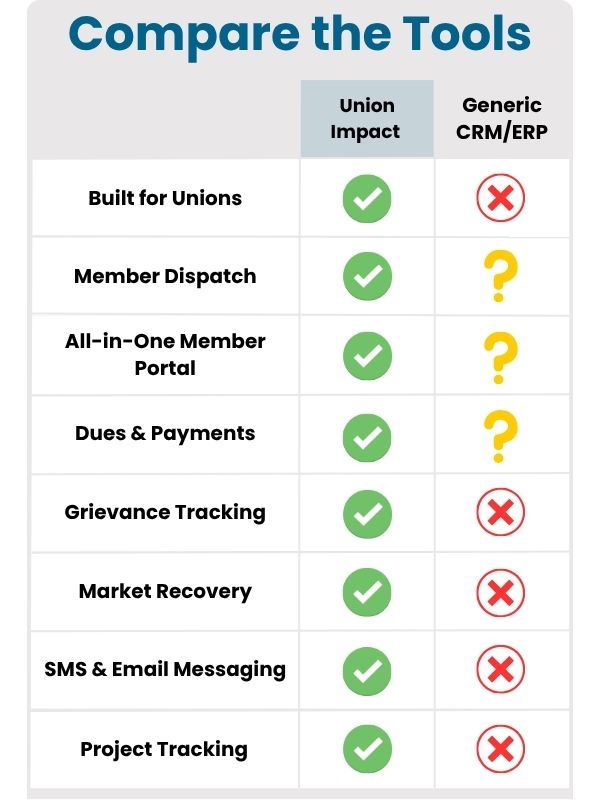
If you are evaluating a purpose-built platform, start with the grievance tracking tool for unions — not because software fixes culture, but because the right system makes good process repeatable.
Your next grievance will not fail because nobody cared. It will fail because nobody could find the file.
Map the contract path before you touch software
Software should reflect reality — not invent it. Export your grievance article (and any side letters) and highlight: timelines, required notices, meeting rules, and what constitutes a complete filing.
Then translate that into a simple stage model every steward can explain in one sentence. If your stages do not match the contract language, reps will route around the system.

Step 1: Define stages and ownership
Most agreements move from written grievance to meetings, responses, and sometimes arbitration. Your system needs stage names that match your local’s vocabulary — not generic labels imported from a vendor demo.
For each stage, answer three questions: Who owns it? What closes it? What is the next trigger? If any answer is “it depends,” write the decision tree until it does not.
| Stage | Minimum record | Owner role |
|---|---|---|
| Filing | Date filed, grievant, work location, articles cited, remedy requested | Chief steward / assigned rep |
| Management response | Response date, outcome, next meeting date | Recording secretary |
| Union review | Advance/withdraw decision, rationale, attachments | Executive board designee |
| Arbitration / resolution | Hearing dates, arbitrator, award language, lessons learned | Legal / lead officer |
Step 2: Standardize the filing packet
Weak filings create weak cases. A structured intake prevents “we will fill in the details later” — because later is where unions lose.
- Identity and work status: member ID, classification, shift, seniority date (if relevant)
- Facts, not adjectives: dates, times, locations, names, and documents — written like you expect a skeptical reader
- Contract hook: exact article/section and why it applies
- Witnesses and evidence: statements, schedules, photos, emails — centralized, not scattered across inboxes
- Remedy: what winning looks like for the member and the union
Union Impact’s grievance management tools are built around structured records so searches and exports stay consistent — even when the roster of reps changes.
Step 3: Make deadlines unavoidable
Calendar math is where locals bleed credibility. “Working days” vs “calendar days,” holiday interruptions, and extensions all need a single source of truth.
A strong digital workflow calculates response windows from the filing date, assigns the responsible rep, and escalates before the deadline — not after. If your tool cannot do that, you will always be one busy week away from a procedural loss.
Step 4: Tie grievances to member context
Grievances do not exist in a vacuum. They connect to discipline history, attendance patterns, dispatch holds, and prior settlements. When a steward opens a member record, they should see the member’s story — not a folder of PDFs named “final_FINAL_v3.”
Integrated data helps you spot retaliation patterns, coach new stewards with real precedents, and protect members from inconsistent treatment.
Step 5: Build reports officers actually use
Reporting is not vanity metrics for the website. It is how elected leaders decide where to spend time: which supervisors generate volume, which articles keep breaking, and where training is missing.
- Grievance volume by unit, employer site, and issue type
- Cycle time by stage (where work stalls)
- Outcomes by step (withdrawn, settled, arbitrated)
- Contract language hotspots for bargaining prep
Your custom union reporting should be queryable by people who are not Excel wizards — otherwise it will not survive leadership transitions.
Step 6: Design for the shop floor, not the back office
If filing requires a desktop, a VPN, and three passwords, stewards will capture notes on paper — and your database becomes fiction. Mobile-friendly, cloud-based access is not a luxury for unions with night shifts, remote sites, and travel.
Union Impact’s union management platform is built as a connected system: members, messaging, documents, and grievances in one place — so the person doing the work is not punished by fragmentation.

Common mistakes locals repeat
Process mistakes
- Letting every rep invent their own intake format
- Mixing “unofficial” steps that never hit the record
- Waiting until arbitration prep to hunt for evidence
Technology mistakes
- Choosing tools that cannot enforce permissions by role
- Storing sensitive documents outside union-controlled storage
- Buying features nobody will maintain after go-live
Go-live checklist (printable discipline)
- Stage model approved by executive leadership
- Intake template matches contract minimums
- Deadline rules documented (calendar vs working days)
- Roles mapped: who can open, edit, close, and export
- Training session recorded + quick-reference one-pager
- Quarterly audit: random sample of 10 cases for completeness
FAQ
Do we need a member portal to track grievances well?
No. Many locals start with strong internal tracking first. A portal can help with transparency later, but integrity begins with steward discipline and officer oversight.
What is the fastest way to get reps to adopt a new system?
Make the first version smaller than you think: one intake form, one reporting view, and one escalation rule. Adoption follows usefulness — not feature count.
How does this tie into bargaining?
Aggregated grievance data reveals systemic issues — staffing, scheduling, safety, and supervision — that anecdote alone rarely proves. Bring charts, not vibes.
Related resources
- Grievance tracking tool for unions
- Member management system
- Custom union reporting
- Union management CRM software products
- Software demo preview
Union Impact provides cloud-based union management software for U.S. and Canadian locals. If you want a walkthrough mapped to your contract language, start with a demo and bring your grievance procedure article.